
What’s Next in Corporate Events? Three Game-Changing Technologies Every Communications Team Should Know
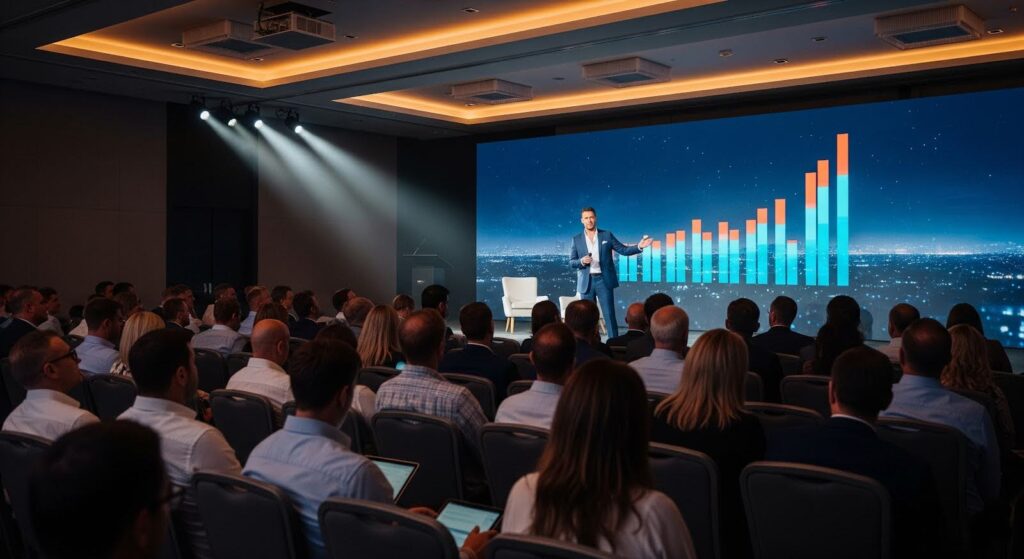
According to PwC’s 2025 AI Business Predictions, 63% of top-performing companies are increasing their AI-related budgets specifically because of emerging technology potential, yet nearly half of organizations still report that AI has made “no noticeable impact” on their business outcomes. Meanwhile, Deloitte’s latest Fortune CEO Survey reveals that while 89% of executives are exploring advanced AI implementations, CEO optimism about their own company performance has dropped from 84% to just 60% in the past six months.
This means that organizations are investing more in communication technologies, but many aren’t seeing the transformative results they expected. We have to think, is the problem really the technology itself, or how companies are implementing it?
Stakeholders demand uninterrupted, accessible, and engaging experiences, whether they’re tuning in from Tokyo boardrooms or home offices somewhere in Canada. Traditional webcast solutions aren’t meeting these expectations anymore.
So, who’s changing the market? These three specific technologies help forward-thinking communications teams create measurable business advantages. We’ll explore how AI-powered real-time tools are revolutionizing audience engagement, why accessibility features have become competitive advantages rather than compliance requirements, and how scalable platforms are helping organizations grow without the painful platform migrations that plague most companies.
AI-Powered Real-Time Communication: Beyond Basic Captions
Do you even remember the last time you watched a live webcast where the captions were completely wrong, or worse, didn’t make sense? For 16% of the global population living with disabilities, that’s just frustrating.
Where AI Delivers (And Where It Doesn’t)
AI-powered captioning promises 98% accuracy rates under ideal conditions, instant multi-language translation, and lower costs than human alternatives. Organizations choose these solutions because they scale effortlessly.
The reality is more complicated. While AI excels with clear audio and standard business vocabulary, it struggles with accents, technical jargon, and rapid-fire Q&A sessions that define high-stakes corporate events. A mistranslated financial term during an investor relations call is just embarrassing, and it can definitely move markets.
This is where experienced event production partners have solved the puzzle: hybrid human-AI transcription models. Instead of choosing between human and AI capabilities, established providers combine both easily. AI handles real-time transcription and basic translation, while human experts provide oversight, context correction, and nuanced interpretation for critical moments.
The Conversation Transformation
Real-time AI tools are modifying stakeholder interaction during events. Modern platforms offer live sentiment analysis that helps presenters gauge audience reaction, automated moderation that filters inappropriate questions, and intelligent routing that connects similar questions for more efficient Q&A sessions.
When participants can follow along in their preferred language and communication style, they stay longer and engage more meaningfully. But implementing these tools requires technical expertise, ongoing calibration, and backup systems that most organizations don’t have the bandwidth to develop internally.
Accessibility as Competitive Advantage
Forward-thinking organizations understand accessibility isn’t a compliance checkbox. It’s a market expansion strategy. When you make your events truly accessible, you’re creating better experiences for everyone.
The Business Case Beyond Compliance
With an estimated disposable income of over $2.6 trillion, people with disabilities anchor the largest emerging market in the world. Organizations that prioritize accessibility see measurable improvements in brand recognition, customer loyalty, and market reach. More importantly, they avoid legal risks that have seen accessibility lawsuits double since 2018.
Universal design principles improve usability for everyone. Live captions help non-native speakers follow complex presentations. Audio descriptions assist people in noisy environments. Keyboard navigation serves users with mobility challenges and power users who prefer efficient shortcuts.
Implementation That Works
Creating accessible events requires more than turning on auto-captions. Professional implementation includes accurate speaker identification, proper timing synchronization, and readable formatting that works across devices.
While building comprehensive accessibility capabilities internally requires significant ongoing investment, working with specialists who have accessibility built into their standard delivery often costs less than developing these capabilities in-house. The ROI comes through expanded audience reach, improved engagement metrics, and eliminated legal risk.
Scalable Solutions That Grow With You
The question isn’t whether your organization will need to scale its communication capabilities. It’s whether you’ll be ready when that growth happens. Organizations that plan for scalability from the beginning avoid painful (and expensive) platform migrations.
Platform Architecture That Actually Scales
Smart organizations seek platforms that allow them to add capabilities as they grow. This might mean starting with basic webcasting and adding operator-assisted conference calls for high-stakes investor events, or reservationless audio for spontaneous team meetings.
The pricing model matters more than you might think. Pay-as-you-go structures work well for organizations with irregular event schedules, while subscription models provide predictable costs for regular communicators.
Established event production partners have already formulated these decisions and can offer flexible engagement models that adapt to your specific growth patterns without requiring you to become experts in platform selection and management.
Global Rollout Realities
When organizations need to rapidly deploy communication capabilities internationally, technical challenges multiply exponentially. Different regions have varying data residency requirements, compliance standards, and network infrastructure limitations. With EvolveSR, we operate globally and deliver events in Asia, Europe and North America.
The most successful international rollouts use template-based event configurations that can be quickly adapted for local requirements while maintaining brand consistency. Building this capability internally requires substantial investment in regional expertise. Many organizations find that partnering with providers who already have global infrastructure delivers better results faster.
Measuring What Matters
Successful organizations grow not just because of technology, but due to their focus on measurement discipline. Engagement scoring systems now track attention span patterns, drop-off points, and interaction quality rather than just attendance numbers.
When companies can demonstrate that stakeholders who attend earnings calls are 40% more likely to maintain their investment positions, communication becomes a measurable business driver rather than a cost center.
The challenge is that sophisticated analytics require ongoing analysis and optimization that pulls internal resources away from core business activities. Specialist providers can deliver these insights as part of their standard service, allowing your team to focus on acting on the data rather than generating it.
The Build vs. Partner Decision
Implementation complexity is exactly why smart organizations are evaluating their build-versus-partner options carefully. The main challenge isn’t the technology itself, but the opportunity cost of having internal teams learn event production instead of concentrating on strategic communication and stakeholder engagement.
Budget allocation becomes clearer when you consider the total cost of ownership. While partnering with specialists requires upfront investment, building these capabilities internally requires specialized staff, ongoing training, equipment investments, and constant technology updates. Many organizations find that the total cost of internal development exceeds specialist partnership costs while delivering inferior results.
Whether it’s employee townhalls that require interactive polling and Q&A management, or investor calls that need professional operators and branded webcasts, successful organizations choose established partners who have already solved the integration challenge and can deliver comprehensive capabilities immediately.
Why the Smartest Teams Are Focusing on Strategy
The organizations thriving in this environment have made a strategic choice. They use AI to enhance stakeholder experiences, implement accessibility as a business strategy, and leverage scalable platforms that grow with their needs. But they don’t build these capabilities themselves.
The technology exists. The business case is clear. The question isn’t whether these capabilities will transform your stakeholder communications. It’s whether you’ll spend the next two years building them internally or start delivering them to your stakeholders next month through the right partnership.
The smartest communications teams have already made this decision. They’re focusing on what they do best while letting specialists handle the technical execution that makes their strategic vision possible.
Ready to take your stakeholder communications to the next level?
Partner with Evolve SR for your Stakeholder Engagement needs and gain access to a complete suite of managed audio and video communication solutions. From professional townhalls to high-profile investor calls, we deliver reliable, impactful, and seamless event experiences that keep your stakeholders engaged and your communications team focused on strategy. Contact Evolve SR today to get started.